
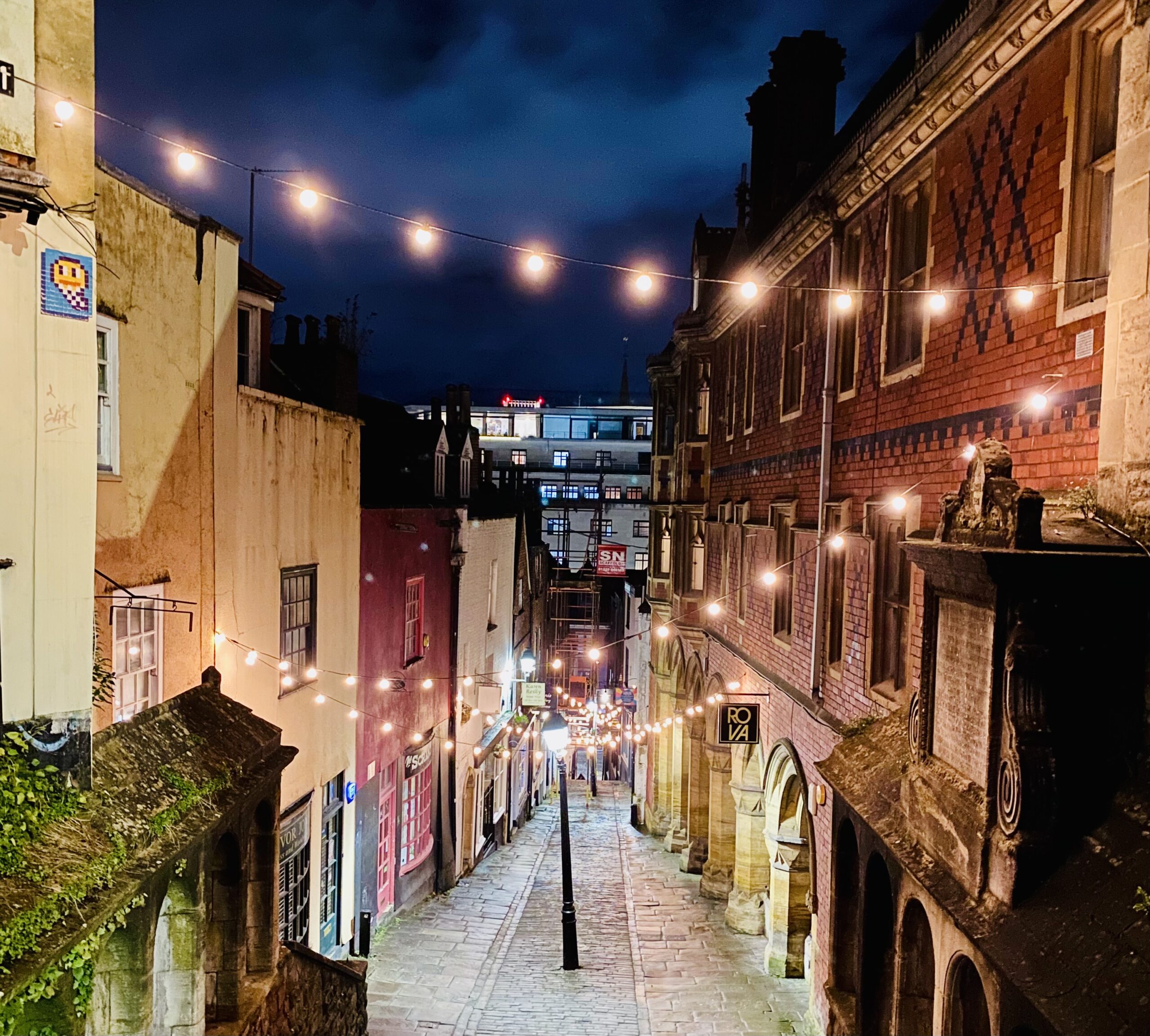
The meandering streets of the Old City still bear the history of the time when medieval traders bustled along the cobbled streets. It’s a vibrant place to visit, with so many historic things to see, and an eclectic range of restaurants and bars, a hotel where spies used to meet, and a two-hundred year old market.
Article Contents
Meeting of waters
It all began one day in the 11th century, when a small Saxon settlement known as Brigstowe, literally meaning village by the bridge, was established at the confluence of two rivers. The River Avon, with its large tidal reach into the channel, and the smaller River Frome, flowing down from the Cotswolds.
It became an important trading hub, as ships could trade with Wales and European ports, and carry goods upstream into the interior of the country. As Bristol’s power and prestige increased, it became the second biggest medieval city in the country after London, rivalling York in the North. This was long before the cities in the Midlands grew to prominence with the Industrial Revolution in later centuries.

In 1155, Bristol was granted a royal charter, and by the 13th century it was one of the wealthiest places in the country, with 10,000 residents. It became a major exporter of wool and cloth, as well as a key port for the import of goods from Wales, Ireland and Europe.
Hidden river
If you are walking into the Old City from the large road system know as the centre, notice the street name, Narrow Quay, because the River Frome used to flow openly along here, with boats mooring along its banks. It is now underneath the streets, emerging into the open at Cascade Steps, by the Watershed Arts Centre. The decision was made to cover it in the 18th century, as the city grew, and the tram and road network developed.
Bristol Bridge is on the same site as the original medieval bridge, which formed a vital crossing point across the River Avon. The old bridge was a dramatic sight, lined with five storey buildings, housing shops with homes above, and even a chapel of the Blessed Virgin Mary. In the 17th century, a former Archbishop of York,, Tobias Matthew, was born above his father’s linen shop on the bridge. It became a bustling commercial district, as the city expanded out of its medieval walls. However, the roadway was narrow and it became overcrowded with carts and pedestrians, and in 1768, it was demolished and the bridge we see today was built.

Let’s go to market
A good starting point to explore the Old City is on Corn Street, which is part pedestrianised with other roads crisscrossing off. The first reminder of medieval history are the unusual bronze tables, called Nails, outside the Corn Exchange. These were used by merchants to seal deals, which is where the phrase, ‘cash on the nail’ came from.
The tradition of trading continues to this day. The Corn Exchange now hosts a daily indoor market, with a huge variety of stalls, from vintage hats and clothes, books and records to an array of different foods. Wander through here, and you’ll find yourself in St Nicholas’s market, over 200 years old, which has a mouthwatering selection of food stalls. And on Wednesdays, a farmer’s market is held outside on Corn Street, selling local produce.
Stroll along Corn Street and take a left into Broad Street, with its two historic Bristol hotels. The Grand Hotel was built in an Italianate Renaissance style in 1874, and became a meeting point for government officials and spies in World War 2. The Clayton Hotel is in the redeveloped Everard printworks, with its stunning Art Nouveau tiled façade, which pays homage to printing pioneers William Morris and Johannes Gutenburg. At the end of this street, the arch of St John the Baptist Church sits dramatically on the old medieval city wall, which is mostly now in ruins or built over.

Bristol blitz
Over the centuries, the hub of the city spread east along the river towards Old Market, forming a commercial district with winding streets of medieval buildings, Georgian shops, workshops and small-scale industry. However, this entire area was devastated on the night of 24 November 1940 by the heavy bombing raids of the Bristol Blitz, aimed at destroying the city’s docks. They missed their target, and instead devastated a quarter of the old city. Raging fires were witnessed from many miles away, killing hundreds of people and leaving the historic buildings and cityscapes as piles of rubble.
In the post-war reconstruction of the 1950s, Broadmead was redeveloped as a modernist style shopping centre, with large department stores. As a child born in the 1960s, shopping trips to Broadmead were a regular occurrence, and I remember visits to M&S, or St Michaels as it was often called then, Lewis’s, and C&A. Woolworths was a special favourite of my young self, with its sweets and soft toys. As a teenager, I used to go there with a group of schoolfriends on a Saturday, to shop at Etam, Miss Selfridge and Dolcis, and have a milkshake at the Wimpy Bar. Now Broadmead seems grey and old fashioned, having been superseded by the nearby indoor shopping centre Cabot Circus, with its Imax cinema and Harvey Nicks.
A section of the bombed area by the river, named Castle Park was designed as an open grassy area around the ruins of St Peter’s church, which was preserved as a memorial to the many people who died in the bombing.
Literary legends
Wander south of the Old City, across Baldwin Street, down the cobbled street named Welsh Back, and take a right turn into King Street. It was built at the end of the English Civil War, and named after King Charles II. However, if history had taken a different turn, it might have been named Cromwell Street!

Here you’ll find the Llandoger Trow, named after the flat bottomed boats that traded between Bristol and Wales. This magnificent 17th century timber-framed pub is steeped in maritime history and literary legend. The pub’s most famous claim to fame is its connection to Daniel Defoe, who allegedly met the real-life castaway who inspired Robinson Crusoe. And on the other side of the street is the Old Duke pub, which is famous for its live jazz sessions.
Another famous local name is Blackbeard the pirate, born as Edward Teach in nearby Redcliffe in 1679. He ruled the waters of the east coast of America and West Indies in the early 18th century. His fearsome reputation came from his mane of dark hair and long beard and, as legend goes, he lit fuses in his beard when attacking enemies, appearing in a menacing cloud of smoke. Check out theatre company Show of Strength’s walk around the haunts of the old sailors and pirates.
Walk along King Street to the Bristol Old Vic, home of the Theatre Royal, which opened in 1766, and is the longest continually operating theatre in England. The BOV schedule includes an exciting range of experimental and traditional shows, featuring local actors and household names. You’ll find Queen Square, with its statuesque Georgian houses and large open grass area to the South of King Street. However, in medieval times this was marsh land used for recreation, including the brutal sports of bear baiting and a bullring.
Street art capital
It would be impossible to wander round the old city and surrounding area without noticing the colourful street art on the sides of buildings. Bristol is now the street art capital of the world, after Banksy gained fame for his stencils which began to appear on the city’s streets back in the 1980s. You can still see Banksy’s works, Well Hung Lover, at the bottom of Park Street, and Mild Mild West, at Stokes Croft. Other iconic murals include Vandal by Bristol artist Nick Walker, in Nelson Street, and Hazard One’s colorful 20-foot high painting in Castle Park, highlighting zero tolerance. Artists from all over the world have painted works in the city, and now there’s a graffiti festival held every two years, Upfest, which is the largest in Europe.

Although not situated in the Old City, a wander round the centre of Bristol should also include a visit to Bristol Cathedral, with its stunning gothic interiors, and a walk up Park Street for a variety of indie and vintage shops. Then take a loop back along Park Row to see the Georgian House museum, and The Red Lodge, an Elizabethan house. Then walk down Christmas Steps, the atmospheric shopping alley which feels like walking into a Dickens novel, back into the centre.
No visit to this area would be complete without experiencing a music event. St Georges, just off Park Street, is a world class concert venue, described by Simon Rattle as ‘the best acoustic for chamber music in Europe.’ Or go to The Bristol Beacon, renamed from the Colston Hall for obvious reasons, which has hosted all the greats, from the Beatles to Bowie. I had my first experience of a live rock concert there – seeing Lou Reed as a teenager.
The Old City is home to some of the best hotels in Bristol, including The Grand Hotel, and The Clayton Hotel. There are also mid-budget options, such as Brooks Guest House, which has two airstream caravans on the roof! And for a budget choice, further along the harbourside is Bristol Youth Hostel.
Do also check out my post on the nearby Harbourside, and also Clifton Village, which is a short walk or bus ride up the hill.
