
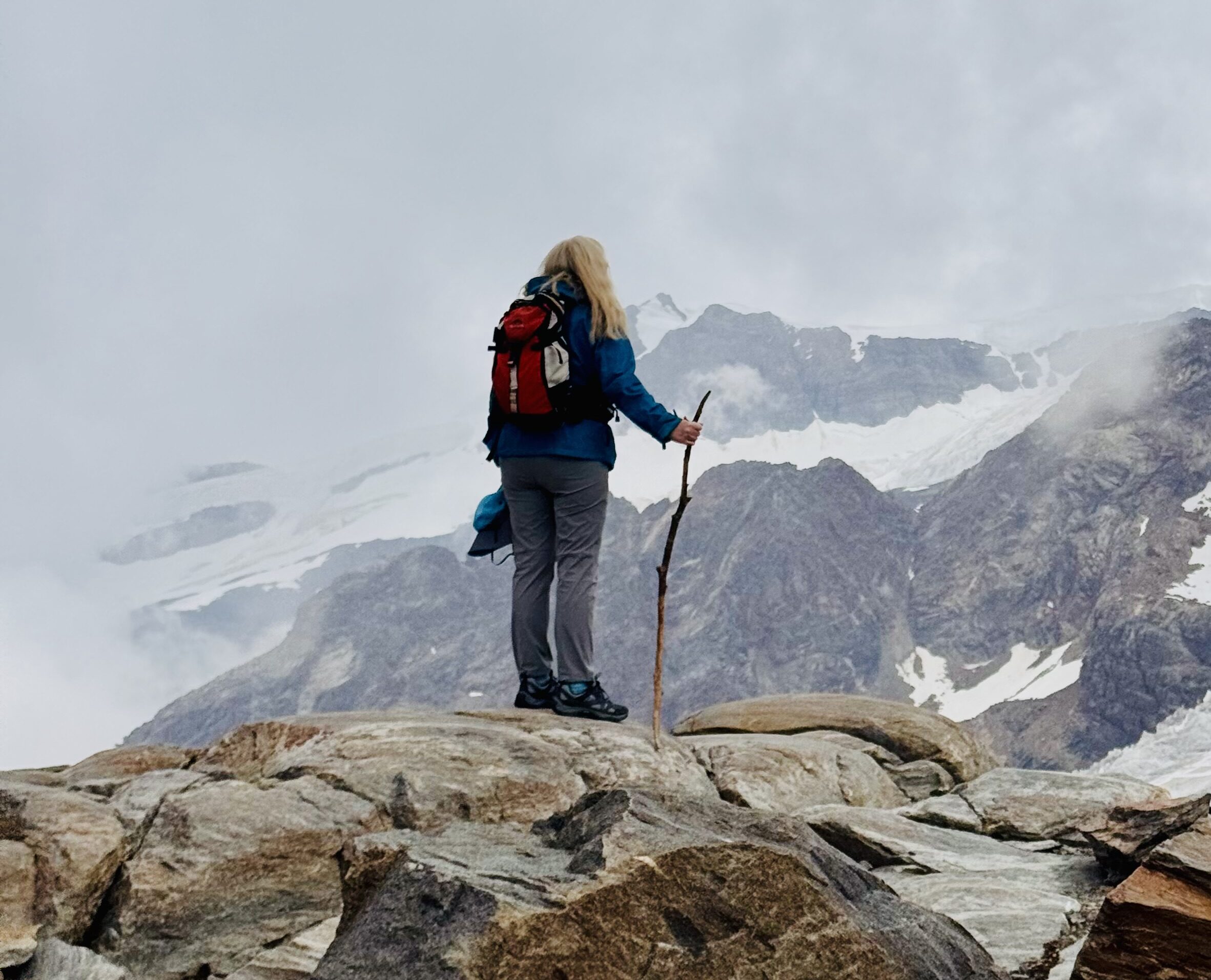
When people think of going on a summer holiday to Italy – it conjures up visions of relaxing on sun drenched beaches and going for boat rides on azure seas. However, after a short flight from Bristol to Milan, and a couple of hours in a car – we found ourselves in the beautiful village of Alagna, surrounded by stunning Alpine scenery.
Article Contents
Walser people
Alagna is actually a group of hamlets at the top of the Sesia Valley, known as Valsesia, with some settlements found at higher altitudes in mountain passes. Its history dates back to the 12th century, when people migrated over the Alps from what is now Switzerland, to find new land for farming. It was a time of historical change in Europe, with groups of peasants being freed from the feudal system and allowed more autonomy.
These German speaking people were known as the Walsers. They established shepherd communities, and turned forests into pastures. They developed new tools and techniques, creating aqueducts to collect snow as it thawed, and terraces for growing crops. At that time, the land was owned by the Monastery of St Nazaro of Biandrate, however, in 1196, the Abbot entrusted the Alp ‘Alania’ to the Walsers, asking for an annual fee of 50 pieces of imperial money and milking on the feast day of St Quirico on 13 July.
They achieved high levels of community welfare, due to their innovative approach to farming the high alpine pastures and freedom from serfdom and taxes, as recorded in the “Free Walser” statutes of the 14th century.

Unique skills
The Walser are also famous for their architecture, which is unique. They predominately used wood for construction, like other forest communities at the time. However, each house has a wide balcony wrapped around the building, with horizontal wooden beams for air circulation. Hay, rye and hemp were dried in these spaces, which were also used for outdoor living and working. Historians have recorded that their construction is more akin to the work of skilled builders, rather than mountain farmers. Many Walser left the Sesia Valley, migrating across Europe to become well known architects and wood carvers.
The Walser women were known for their fine weaving and embroidery, producing beautiful traditional clothes worn in festivals. These can be seen at the Walser Museum, along with many original tools used in housework and farming.
The Walser language is still spoken in Alagna. It is an archaic form of German, which due to mountain isolation, has been immune to the influence of nearby Italian dialects, and modern German.
Hiking trails
The Valsesia Valley is a haven for hikers in the summer, with many things to see and do. And in winter it attracts experienced skiers seeking the thrill and challenge of the off-piste routes for which Alagna is famous. It is known as a free ride paradise, with over 180 kms of trails to explore, across three valleys. We hiked up a different path each day, through alpine pastures with wildflowers, and over mountain passes. One morning we climbed the steep track through fir and larch forests to Otro, a group of hamlets perched on high slopes. A man passed us carrying an easy chair to deliver to a home, as the only access is on foot! We stopped in the hamlet of Follu to admire the church of Madonna della Neve, and have a coffee in a small restaurant.

Monte Rosa
After acclimatising to higher altitudes, we set off for Monte Rosa, the second highest mountain in the Alps. We took three ski lifts up to the Indren Glacier, at a heady 3,500 metres above sea level, 1,250 metres higher than Mexico City! The air was thin and I experienced mild altitude sickness, with nausea and shortness of breath.
We crossed the glacier, snowy slopes, and traversed a cliff with ropes. Then we hiked up a rocky track to reach the Mantova Refuge. Hikers and climbers can stay here the night before venturing further up the mountain. We had a snack, and enjoyed spectacular views of the Garstelet Glacier. Scientific research and photographic evidence show that both glaciers are retreating as a result of climate change.

Friar Gnifetti
We could also see the Gnifetti Refuge further up the mountain, named after Friar Gnifetti, the parish priest of Alagna in the early 19th century. He became famous for his historic climb of the one of the highest peaks of Monte Rosa in August 1842. This was achieved after several years of preparation, and three unsuccessful attempts.
Maybe one day I’ll join other hikers walking the Monte Rosa Tour, a circuit around the mountain following many ancient trails which have linked the Swiss and Italian valleys for centuries. It sounds amazing – trekking for 10 days along high balcony trails, through forests and meadows, and staying in mountain refuges. Although I’ll need to get into some serious training before attempting it!
Wish list
There are so many amazing and scenic places to visit a fairly short drive north of Milan for a summer holiday. And with summers in Southern Europe becoming dangerously hot, it is an attractive prospect to escape into the cooler air of the mountains. Now that I’ve experienced the Alpine landscapes of Alagna, I’d like to add the Dolomites and Lake Como to my summer holiday wish list. And it’s so easy, with daily two-hour flights from Bristol Airport! Within a few hours, you can be relaxing in a mountain paradise!
